Version: v2.9.0

Architecture

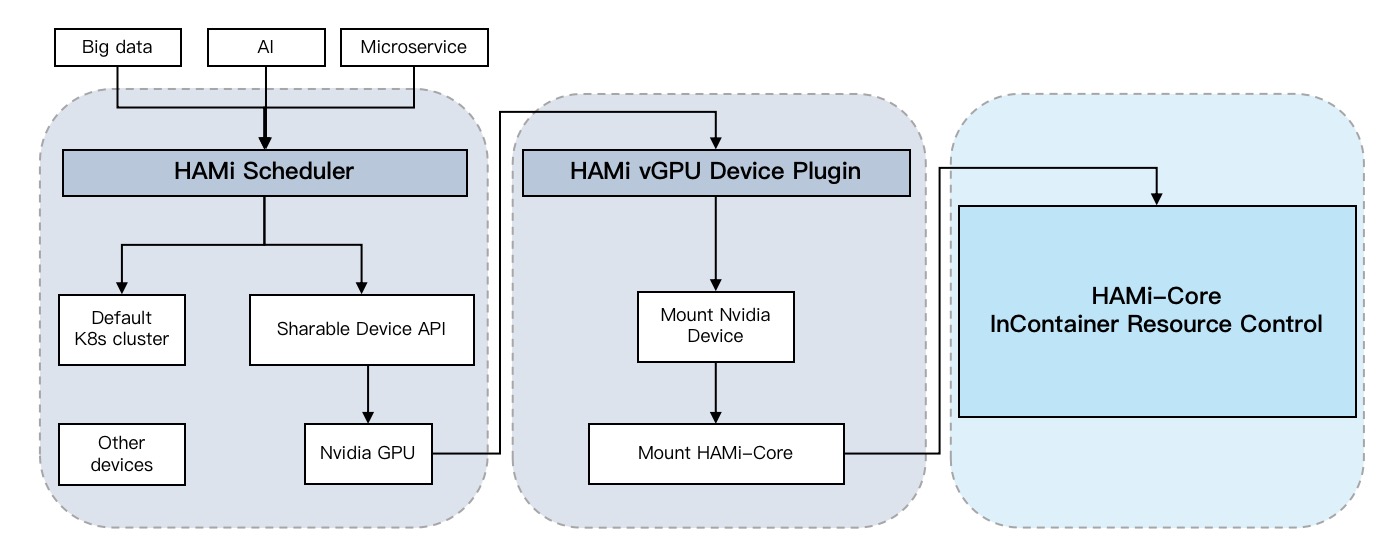
HAMi extends Kubernetes with device-aware scheduling and runtime resource controls for heterogeneous AI accelerators. Its architecture separates cluster-wide placement decisions from node-level device allocation and, where supported, in-container enforcement.

HAMi components and the GPU workload scheduling sequence

What are HAMi's core components?

HAMi coordinates four components during the lifecycle of an accelerator workload:

ComponentRuns asPrimary responsibility
HAMi MutatingWebhookPart of the hami-scheduler deploymentDirects Pods that request HAMi-managed resources to hami-scheduler
HAMi scheduler extenderPart of the hami-scheduler deploymentSelects a node and a physical device from a cluster-wide view of available resources
HAMi device pluginDaemonSet on accelerator nodesRegisters devices with kubelet and prepares the selected device for the container
HAMi-CoreLibrary injected into supported containersEnforces the assigned memory and compute limits at runtime

The exact resources and enforcement mechanism depend on the device vendor. For example, NVIDIA workloads can request nvidia.com/gpumem in MiB and nvidia.com/gpucores as a percentage. Other devices expose vendor-specific resources and may support different allocation granularities. See the FAQ for the current support matrix.

How does a workload move through HAMi?

  1. Admission: When a Pod requests a HAMi-managed device, the MutatingWebhook sets spec.schedulerName to hami-scheduler unless the Pod already names a scheduler.
  2. Placement: The HAMi scheduler extender combines the Pod request with device information reported by each node. During scheduling, it filters nodes that cannot satisfy the request and selects a suitable physical device.
  3. Allocation: The scheduler records the selected device and quota in Pod annotations. On the chosen node, kubelet calls the HAMi device plugin, which reads that result and makes the device available to the container.
  4. Runtime control: For devices that support in-container control, the device plugin injects the required runtime library and configuration. For NVIDIA virtual GPUs, HAMi-Core intercepts relevant CUDA and NVML calls to apply the assigned memory and compute limits.

This division keeps cluster policy in the control plane, hardware discovery and allocation on each node, and workload-level enforcement close to the application.

HAMi MutatingWebhook

The MutatingWebhook is the admission entry point. It examines a newly created Pod's resource requests to determine whether HAMi should handle it. For eligible Pods, it sets:

spec:
schedulerName: hami-scheduler

Pods that do not request HAMi-managed resources continue through the normal Kubernetes scheduling path. Pods that explicitly choose another scheduler are not silently reassigned.

HAMi Scheduler

The scheduler is responsible for choosing both a node and a device. Kubernetes device plugins normally advertise integer resource counts, which are not enough to describe properties such as device model, memory capacity, compute capacity, health, or topology. HAMi device plugins therefore report detailed device information through node annotations, allowing the scheduler to maintain a cluster-wide view.

HAMi participates in the standard scheduling flow as a scheduler extender; it does not replace Kubernetes scheduling. It filters candidates according to the requested resources, applies the configured binpack or spread policy, binds the Pod, and writes the allocation result to annotations such as hami.io/vgpu-devices-allocated.

Device Plugin

The HAMi device plugin runs on each supported accelerator node and implements the Kubernetes device plugin API. It discovers local devices, registers allocatable resources with kubelet, reports device details for scheduling, and handles kubelet's Allocate request after a Pod is bound.

During allocation, the plugin reads the scheduler's result from the Pod annotations and exposes the selected device to the container. Depending on the vendor integration, it may mount device files and runtime libraries or inject environment variables that describe the assigned quota.

HAMi-Core

HAMi-Core provides runtime control for NVIDIA virtual GPUs through libvgpu.so. The device plugin loads the library into the container through /etc/ld.so.preload. HAMi-Core then intercepts CUDA memory allocation and kernel launch calls: allocations beyond the assigned memory budget return an out-of-memory error, while compute usage is throttled toward the requested limit. It also adjusts NVML results so applications see their assigned memory rather than the full physical device.

This is user-space enforcement, not a hardware security boundary. Applications that bypass the intercepted libraries—for example, by using direct driver calls or Docker-in-Docker—may bypass these controls. Use NVIDIA MIG when a supported GPU and hardware-enforced isolation are required. See GPU Virtualization Principles for the full interception and allocation flow.

How does HAMi compare with time-slicing and MIG?

ApproachSharing modelMemory and compute boundaryBest fit
Time-slicingWorkloads take turns on one GPUNo per-workload GPU memory isolationSimple concurrency where strict quotas are unnecessary
HAMi virtual GPUWorkloads share a GPU with flexible requested quotasUser-space memory enforcement and compute throttlingFine-grained, dynamic sharing across a broad range of GPUs
NVIDIA MIGA supported GPU is divided into fixed hardware partitionsHardware-enforced memory and compute isolationStrong isolation on MIG-capable GPUs

HAMi also supports dynamic MIG allocation, so these approaches are not always mutually exclusive. The right choice depends on the accelerator, workload, isolation requirement, and desired partition granularity.

Product architecture and reference deployment

This page describes HAMi's product components and the request lifecycle common to its integrations. A complete cluster can also include a CNI, vendor drivers and runtimes, monitoring, and an optional dashboard. For one NVIDIA-oriented deployment topology and its dependencies, see HAMi Cluster Architecture After Installation.

References

What's next

CNCFHAMi is a CNCF Incubating project